Agent-based configuration management is pull-based, and requires installation of an agent on the switch. When agents are used for switch management, they can be installed in the native Linux user-space, a Linux Container (LXC), or the guest shell. Communication between agents and master nodes is accomplished through the network, and agents should be configured for secure, encrypted communication between master nodes and agents.
While bash will run agents directly within the shell, guest shell has the capability to install agents within an LXC, or to run an open virtual format (OVF/OVA) machine, which can be launched from the bootflash directory. Guest shell ensures agent-based operations are isolated from the underlying host context to ensure security
Puppet and Chef are examples of agent-based configuration management tools.
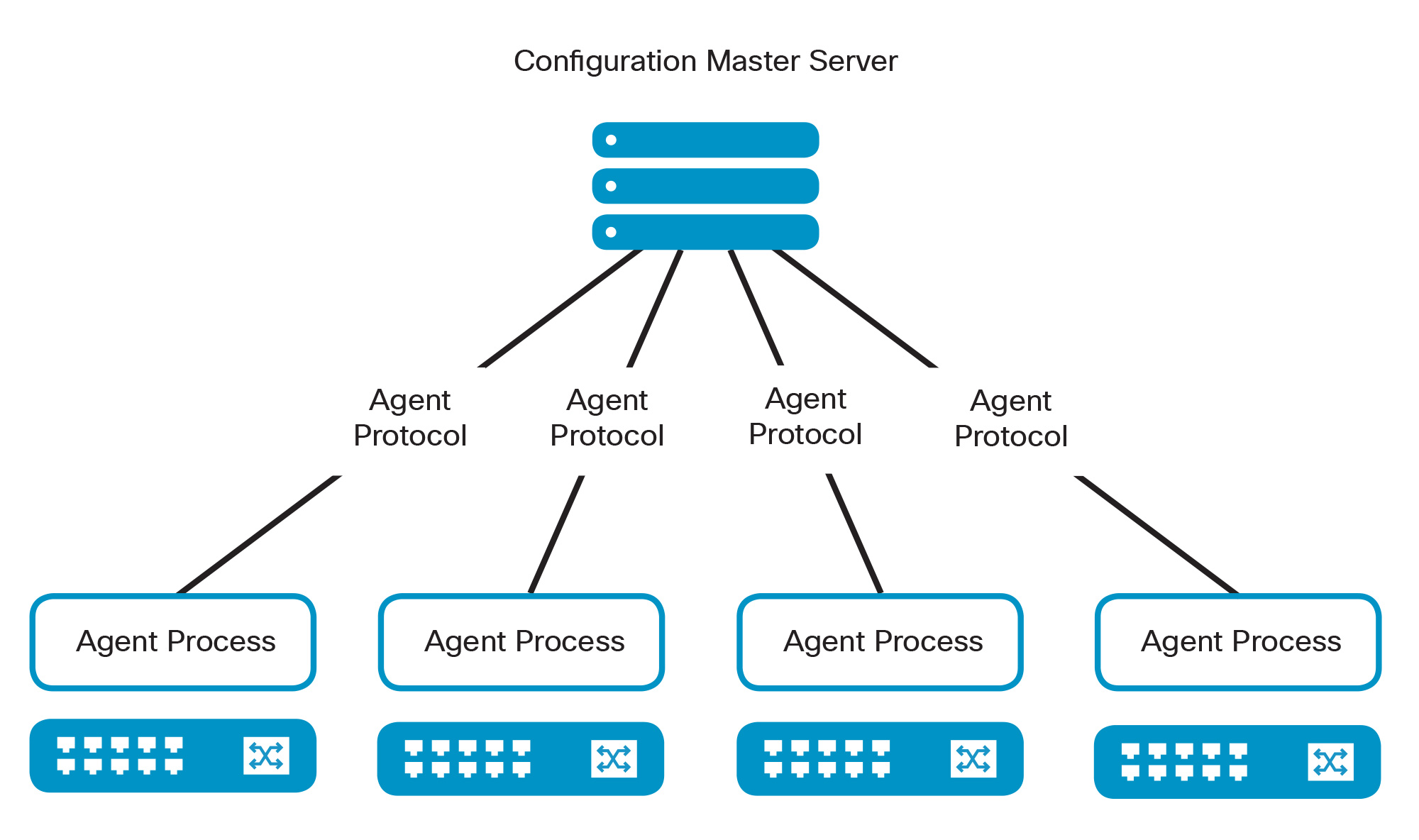
Puppet and Chef Leverage an Agent on the Open NX-OS Switch
In summary, configuration management tools have been proven in server automation enviroments, and can be extended to network infrastructure components using a common configuration management framework.