Introduction
Smart Bonding Documentation
Welcome to the Cisco Smart Bonding API documentation — your guide to connecting a Cisco Partner's ITSM (IT Service Management) system with Cisco's support ticketing system for seamless, automated ticket synchronization.
Note: This documentation describes how to connect a partner ITSM system to Cisco TAC (Technical Assistance Center) via Smart Bonding. Guidance for customers differs slightly and will be published at a later stage. For customer-specific questions about using this API, contact the Smart Bonding support team. For API technical support, see Community & Support.
For more about Cisco's support ticketing system, see the Cisco Support page and My Support.
What is Smart Bonding?
Smart Bonding connects a Cisco Partner's ITSM system (the ticketing tools used for case management) to Cisco TAC, enabling real-time synchronization of support cases. This standardized integration delivers three strategic advantages:
- Speed up time to market: A single, standardized integration method improves agility and economies of scale as partner networks grow. Quick, repeatable onboarding lets partners keep pace with business demand.
- Increase partner satisfaction: Accelerated service delivery and continuous processes shorten time to resolution, provide end-to-end transparency, and elevate the overall service experience.
- Reduce operating expenses: Simplified processes eliminate manual effort and boost resource productivity. A cloud-based, pay-as-you-grow model drives faster time to value and greater ROI (Return On Investment).
Building a Cisco TAC connection for incident exchange delivers further benefits:
- Process automation: Machine-to-machine communication reduces manual work, and automated steps can be added to streamline workflows.
- Faster mean time to closure: Real-time collaboration and information transfer reduce the need for manual intervention, achieving a mean time to resolution improvement of up to 45%.
- Easier ticket and progress tracking: All ticket information is stored in a machine-readable format within a single system, enabling automated reporting and time tracking.
- No more swivel chair: Automatic integration saves time and eliminates duplicate data entry.
The value of Cisco Smart Bonding extends well beyond cost savings and efficiency — it closes the gap for truly effective service integration and management, accomplishing what one-off, custom connections cannot. It gives end users a single, unified view of their entire support ecosystem. Smart Bonding helps partners meet multi-sourcing challenges and improve outcomes in outsourcing engagements, managing large numbers of service delivery partners with real-time communication and complete visibility across the service delivery process.
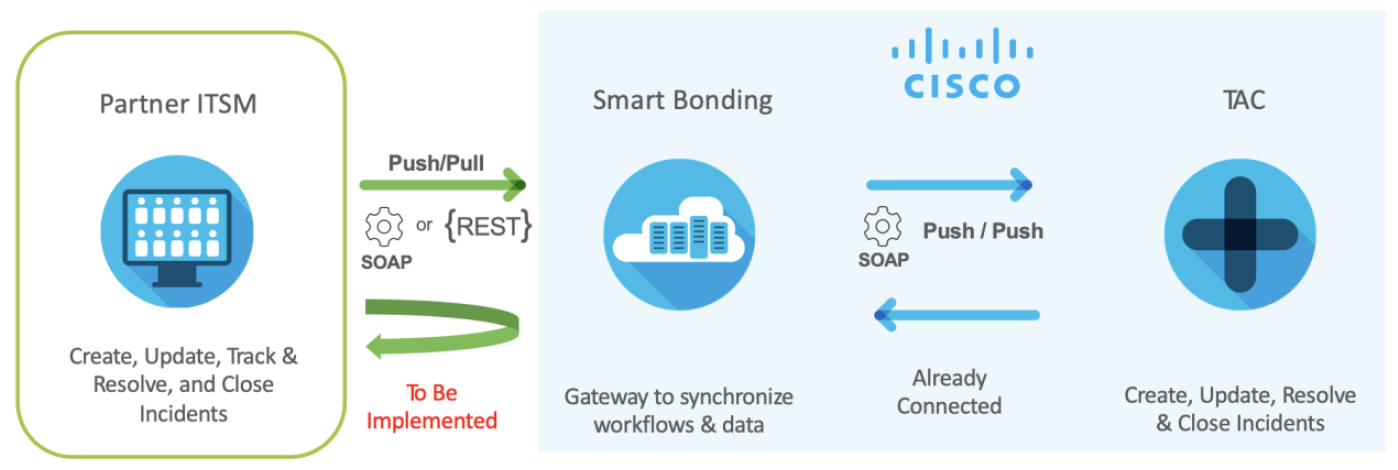
Two Ways to Use Smart Bonding
Cisco provides two integration paths for Smart Bonding, so partners can adopt the approach that best fits their existing environment. Both options are offered at no cost.
ServiceNow App — If your organization runs on ServiceNow, you can integrate simply by installing and configuring the Cisco-provided Smart Bonding app. There is no need to build a custom API connection; setup is handled by a ServiceNow administrator, making this the fastest path to a working integration.
Self-Onboarding API — If you use a non-ServiceNow ITSM platform (or prefer full control of the connection), you can integrate directly through the Smart Bonding self-onboarding API. This approach works with any ITSM platform and requires an ITSM developer to implement the API connection for sending and retrieving information.
The "Getting Started" section compares both approaches in detail.